
Introduction
The rapid development of humanoid robots is driving new requirements for electric drive systems. Unlike traditional industrial robots that operate in fixed environments, humanoid robots must achieve human-like movement, including walking, balance control, precise manipulation, and dynamic interaction.
To meet these challenges, robot manufacturers require motors that combine high torque output, compact size, lightweight design, and fast response. Traditional radial flux motors, although widely used, are facing increasing limitations in applications where space and weight are highly constrained.
As a result, axial flux motors are attracting growing attention as a promising drive technology for next-generation humanoid robots.
The Challenge of Humanoid Robot Actuation
A humanoid robot requires dozens of actuated joints to replicate human movement. Each joint must deliver sufficient torque while maintaining a compact and lightweight structure.
For robotic applications, the motor system needs to achieve several critical requirements:
High Torque Density
Robot joints require strong torque output within limited installation space. Higher torque density allows designers to reduce actuator size while maintaining performance.
Lightweight Structure
Every additional kilogram increases energy consumption and affects robot mobility. Lightweight motors help improve operating efficiency and extend battery life.
Fast Dynamic Response
Humanoid robots need rapid acceleration, precise positioning, and real-time motion adjustments. The motor must respond quickly to control commands.
Reliable Long-Term Operation
Robots designed for commercial applications require stable performance under continuous operation, making thermal management and manufacturing consistency essential.
These requirements are pushing engineers to explore new motor architectures beyond conventional designs.
Axial Flux Motor: A New Generation of Electric Drive Technology
Axial flux motors use a different magnetic structure compared with traditional radial flux motors.
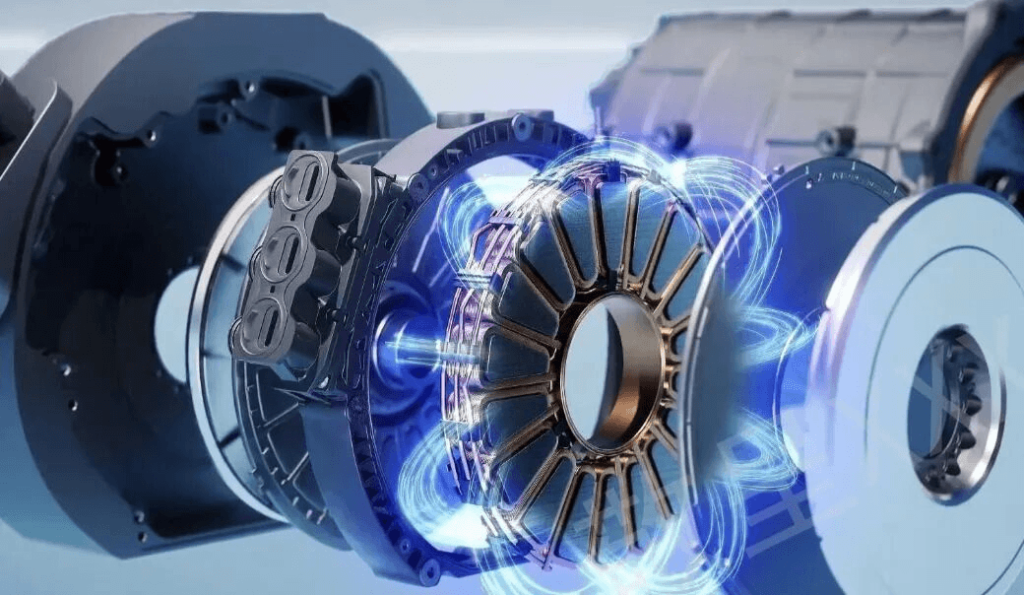
In a radial flux motor, magnetic flux flows radially across the air gap between the rotor and stator. In an axial flux motor, magnetic flux flows parallel to the motor shaft, creating a disc-shaped structure.
This unique architecture provides several advantages:
Compact and Lightweight Design
The flat structure of axial flux motors enables a shorter axial length compared with conventional motors with similar power output.
For humanoid robots, where joint space is extremely limited, this compact design creates more flexibility for mechanical integration.
Higher Torque Density
Because of the optimized magnetic path and larger effective radius, axial flux motors can generate higher torque within a smaller volume.
This makes them suitable for robotic joints that require powerful output without increasing actuator size.
Improved Energy Efficiency
A lightweight and efficient motor reduces energy consumption, which is especially important for battery-powered robots.
Higher efficiency helps extend operating time and improves the overall performance of robotic systems.
SEMOTOR Axial Flux Motor Solutions for Robotics
As a specialist in axial flux motor technology, SEMOTOR focuses on developing high-performance electric drive solutions for advanced robotics and intelligent equipment.
The company’s integrated joint motor modules combine:
- Axial flux motor technology
- Precision reducer systems
- Motor drivers
- Brake systems
This integrated approach simplifies robotic actuator design while improving system reliability and performance.
SEMOTOR’s axial flux motors feature:
- Peak efficiency exceeding 97.5%
- Torque density up to 260 Nm/kg
- Power density up to 10 kW/kg
These characteristics make them suitable for applications including:
- Humanoid robot joints
- Quadruped robotic systems
- Industrial robotic platforms
- Autonomous vehicles
- Advanced intelligent equipment
From Laboratory Technology to Mass Production
For advanced motor technologies, achieving reliable mass production is as important as technological innovation.
SEMOTOR combines independent research and development with scalable manufacturing capabilities to support commercial applications.
The company is developing an automated axial flux motor production line with a planned annual capacity exceeding 150,000 units.
Through precision manufacturing, intelligent inspection, and digital production management, SEMOTOR aims to provide consistent and reliable electric drive solutions for global customers.
The Future of Humanoid Robots Requires Better Motor Technology
Humanoid robots represent one of the most challenging applications in modern robotics. Their success depends not only on artificial intelligence and software algorithms but also on the performance of core hardware components.
Motor technology is one of the key foundations determining robot mobility, efficiency, and commercial viability.
With advantages in size, weight, torque density, and efficiency, axial flux motors are becoming an important direction for future robotic actuation systems.
SEMOTOR continues to advance axial flux motor innovation, helping global partners build more powerful, efficient, and intelligent robotic systems.
SEMOTOR — Empowering Next-Generation Intelligent Equipment with Ultimate Power.